Bibliography:
On the iAligner project
Projects on textual variants and collation
On the concept of the syntax-based alignment, semi-automatic collation and related algorithms
On Levensthein distance and related projects
Other projects on exploration of text reuse
Projects on textual variants and collation
- CollateX: www.collatex.net
- Digital Variants project: www.digitalvariants.org
- eComparatio project: www.ecomparatio.net
- Samuel Beckett Digital Manuscript Project: www.beckettarchive.org
- Stemmaweb: www.stemmaweb.net
- AA. VV., The “Gothenburg model”: A modular architecture for computer-aided collation
- Andrews, T.L., Blockeel, H., “Analyzing manuscript traditions using constraint-based data mining”, in Proceedings of the ECAI 2012 CoCoMiLe workshop on COmbining COnstraint solving with MIning and LEarning (Montpellier, August 2012).
- Andrews, T.L., “The third way: Philology and Critical Edition for a Digital Age”, Variants 10, 2013, 61-76
- Dekker, Ronald H. et al. “Computer-supported collation of modern manuscripts: CollateX and the Beckett Digital Manuscript Project.” Digital Scholarship in the Humanities, Oxford, 2014.
- Jänicke, S., Büchler, M. and Scheuermann, G., “Improving the Layout for Text Variant Graphs”, in VisLR workshop at LREC Conference 2014, Reykjiavik, Iceland.
- Jänicke, S., Geßner, A., et al. “TRAViz: A Visualization for Variant Graphs”, Digital Scholarship in the Humanities (Digital Humanities 2014 Special Issue)
- Schubert, C., Meins, F., et al., “eComparatio - Editionsvergleich”, in Digital Humanities 2016: Conference Abstracts. Jagiellonian University & Pedagogical University, Kraków, pp. 882-883.
On the concept of the syntax-based alignment, semi-automatic collation and related algorithms
- Brown, P.F., et al. “Aligning sentences in parallel corpora”. Proceedings of the 29th Annual Meeting of the Association for Computational Linguistics, Berkeley 1991, 169–176.
- Makedon, F. et al. “HEAR HOMER: A multimedia-data access remote prototype for ancient texts.” Proceedings of ED-MEDIA’98. Freiburg, Germany, 1998.
- Mount, D.M., Bioinformatics: Sequence and Genome Analysis, New York 2004 (2nd ed.).
- Needleman, S.B. and Wunsch, C.D. “A General Method Applicable to the Search for Similarities in the Amino Acid Sequence of Two Proteins”. Journal of Molecular Biology, 48(1970): 443–453.
- Spence, M., Howe, C., “Collating texts using progressive multiple alignment”, Computers and the Humanities, August 2004, Volume 38, Issue 3, pp 253-270.
- Thompson, JD, et al. “CLUSTAL W: Improving the Sensitivity of Progressive Multiple Sequence Alignment through Sequence Weighting, Position-Specific Gap Penalties and Weight Matrix Choice”. Nucleic Acids Research, 22(1994): 4673– 4680.
On Levensthein distance and related projects
- Büchler, M., Franzini, et al., “Scaling Historical Text Re-Use”, in The IEEE International Conference on Big Data 2014 (IEEE BigData 2014). Washington DC, October 2014, 27-30.
- Jänicke, S., Geßner, A., et al., "Visualizations for text re-use". In IVAPP ‘14: Proceedings of the 5th International Conference on Information Visualization Theory and Application, 2014.
- Moritz, M., Wiederhold, A., et al. (forthcoming 2016) “Non-Literal Text Reuse in Historical Texts: An Approach to Identify Reuse Transformations and its Application to Bible Reuse”, in EMNLP 2016: Empirical Methods in Natural Language Processing. Austin, November 2016, 1-5.
- Schubert, C., “Das Portal eAQUA - Neue Methoden der geisteswissenschaftlichen Forschung II”, in: W. Fach, F. Kolovou, S. Rieckhoff, B. Streck, Working Papers Contested Order No.3, Oktober 2011.
- Schubert, C., Heyer, G., “Neue Methoden der geisteswissenschaftlichen Forschung. Eine Einführung in das Portal eAQUA”, in W. Fach, F. Kolovou, S. Rieckhoff, B. Streck, Working Papers Contested Order No.1, Oktober 2010.
- eAQUA Portal: www.eaqua.net
- Tesserae Project for exploring intertextual parallels: http://tesserae.caset.buffalo.edu/
 Choose an option to refine the alignment according to specific criteria (ignore punctuation, ignore diacritics, case sensitive or Levensthein Distance). Documentation on every single option to be added.
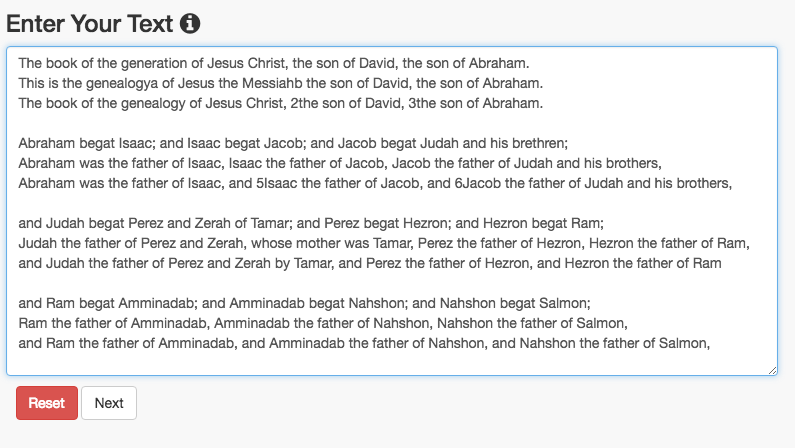
Click on “Next” to visualize the tokenized sentences, then click “Align” to visualize the alignment.
Choose an option to refine the alignment according to specific criteria (ignore punctuation, ignore diacritics, case sensitive or Levensthein Distance). Documentation on every single option to be added.
Click on “Next” to visualize the tokenized sentences, then click “Align” to visualize the alignment.